- Reg52
- Posts
- A Shift in OFSI Sanctions Compliance is happening in 2025
A Shift in OFSI Sanctions Compliance is happening in 2025
Here's 7 points you can make to your ExCo as an MLRO or Head of Sanctions

Paul Huston
March 23, 2025
UK MLROs & Sanctions Heads — heading into a Board/ExCo update this week?
Here's 6 themes from OFSI's recent review that could help your message.
1. OFSI Is Shifting Gears — Fast. It's not tinkering, it's transforming.
2. 4x Enforcement Surge = Increasing Expectations
3. £3.1M Into Data Deep-dive = Sanctions Compliance Goes Automated
4. Licensing Is Going Lean — And Soon, Machine
5. Maritime Sanctions Are a Test Case — Your Sector Might Be Next
6. Disclosures Are the New Deterrent
OFSI has focussed on becoming a data-driven, intelligence-led agency which is increasing enforcements (in contrast to the shift in the US)
Sanctions compliance is now a core part of UK economic and geopolitical security
UK Treasury has higher strategic and operational standard expectations for Sanctions & Money Laundering programs
1. A Shift in OFSI Compliance Philosophy is happening
Old Model: Transactional, document-driven, guided by static regulations.
New Model: Proactive, intelligence-based, aligned with national security. OFSI is increasingly leveraging national security infrastructure (e.g., MoD, JMSC) Sanctions compliance is now part of the UK’s economic deterrence strategy
Expectation: Heightened interest, more demanded of Sanctions programmes in the UK
2. 4x Resources for Enforcement…
OFSI staffing quadrupled in enforcement/licensing; advanced tools deployed.
Expectation: Firms evolve from basic compliance to mature intelligence-led functions
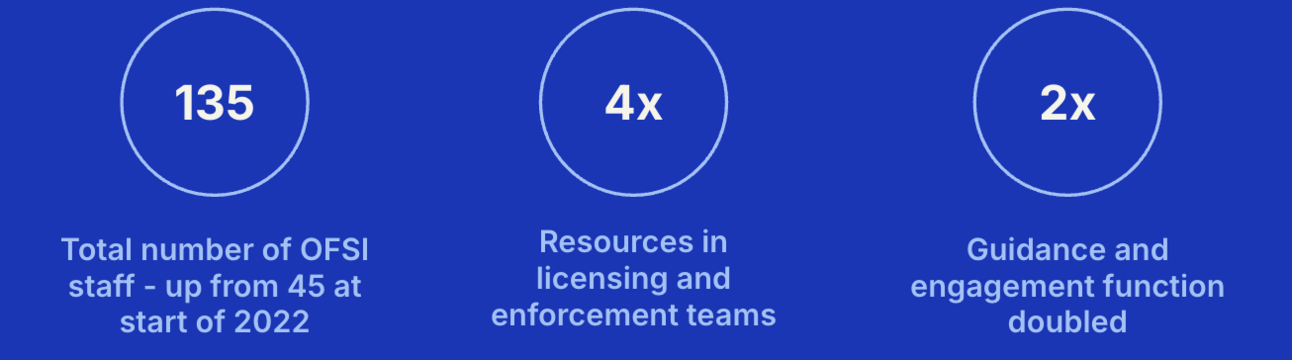
4x increase for OFSI Enforcement spend
3. …with new tools + OFSI Data Roadmap
This expansion in staff has come with investment in new tools and processes:
Advanced data analytics (reportedly £420k annual contract)
Cryptocurrency investigation capabilities
Access to specialist platforms for corporate record and data sets
The £50m Economic Deterrence Initiative (EDI) led to a £3.1m data investment (see UK Treasury doc here & snippet below):
Data capabilities deep-dive across architecture, processing, protection
OFSI now claim to have a data roadmap to deliver this - moving them to a proactive, intelligence-led enforcement model

The £50m Economic Deterrence Initiative (EDI) led to a £3.1m data investment
4. Delegated licensing could signal future automation
Non-senior civil servants can now approve license decisions
To be debated, but the release of Licensing Principles potentially provides a framework triage-based licensing algorithms Automated detection across the financial sector
Implication: Faster regulatory feedback loops = Less room for lagging compliance

OFSI Designated Individuals Licensing Principles
5. Maritime Evasion Typologies as a Template for other sectors
OFSI is testing cross-sector pattern recognition first in the Maritime sector.
To be debated, but the release of Licensing Principles potentially provides a framework triage-based licensing algorithms Automated detection across the financial sector.

Maritime is the test vehicle for OFSI
Data Modelling - Behavioural signatures for circumvention
Collaboration - Collaboration pipelines with non-financial regulators (DfT, MoD) via JMSC
Indirect risk - Systems to trace complex value chains through partial visibility
Implication for Sanctions Programs: OFSI will apply the same modelling to other sectors next — especially where complex supply chains + financial services intersect (e.g. trade finance, commodities).
If you're touching physical movement of value (even indirectly), this modelling is coming for your customers too.
6. Disclosure Powers – A New Public Accountability Tool

How OFSI has set out its use of Disclosure Powers
Somewhat know about OFSI’s new Disclosure Powers? Here’s an explainer/FAQ:
What are they?
Disclosures are an important part of OFSI’s expanded enforcement arsenal and ensure it can take proportionate action, and promote compliance lessons, across the full spectrum of severity.
When can they be used from?
Disclosures are available to OFSI in cases where a breach occurred from 15 June 2022 (via the Economic Crime (Transparency and Enforcement Act 2022)
Why would they be used?
Disclosures are intended for moderately severe cases and where OFSI considers a warning letter would be too lenient, but a monetary penalty would be disproportionately punitive.
When were they used first?
On 31st August 2023, OFSI made first use of this power by publishing a report naming Wise Payments Limited (“Wise”) for breaching regulation 12 of The Russia (Sanctions) EU Exit Regulations 2019 (“the Russia Regulations”).
6. Strategic Recommendations for MLROs & Heads of Sanctions
Shift from reactive to anticipatory sanctions compliance
Integrate geopolitical risk into risk assessments
Review and align with OFSI typologies and JMLIT intelligence
Prepare for greater automation and scrutiny across crypto, payments, maritime
Embed public accountability and reputational risk into compliance policy
7. Closing Message to your ExCo/Board
Sanctions compliance is now strategic, not just regulatory
OFSI’s shift demands corresponding elevation of compliance capabilities
Investment in people, data, and detection will define resilience in 2025 and beyond